Blue Origin · 2017–2021
Hired for the manufacturing systems. Left having founded the design organization.
In 2017 Blue Origin hired me to run product for the internal platforms that build flight hardware: manufacturing execution, supply chain, and the workflows that govern mission readiness. Four years later I left having created two marquee platforms of the company's enterprise suite, founded the company's first Experience Design organization, defined the commercial astronaut experience, and been selected as Astronaut 6 for the first full crew rehearsals. This page is the route between those two things.
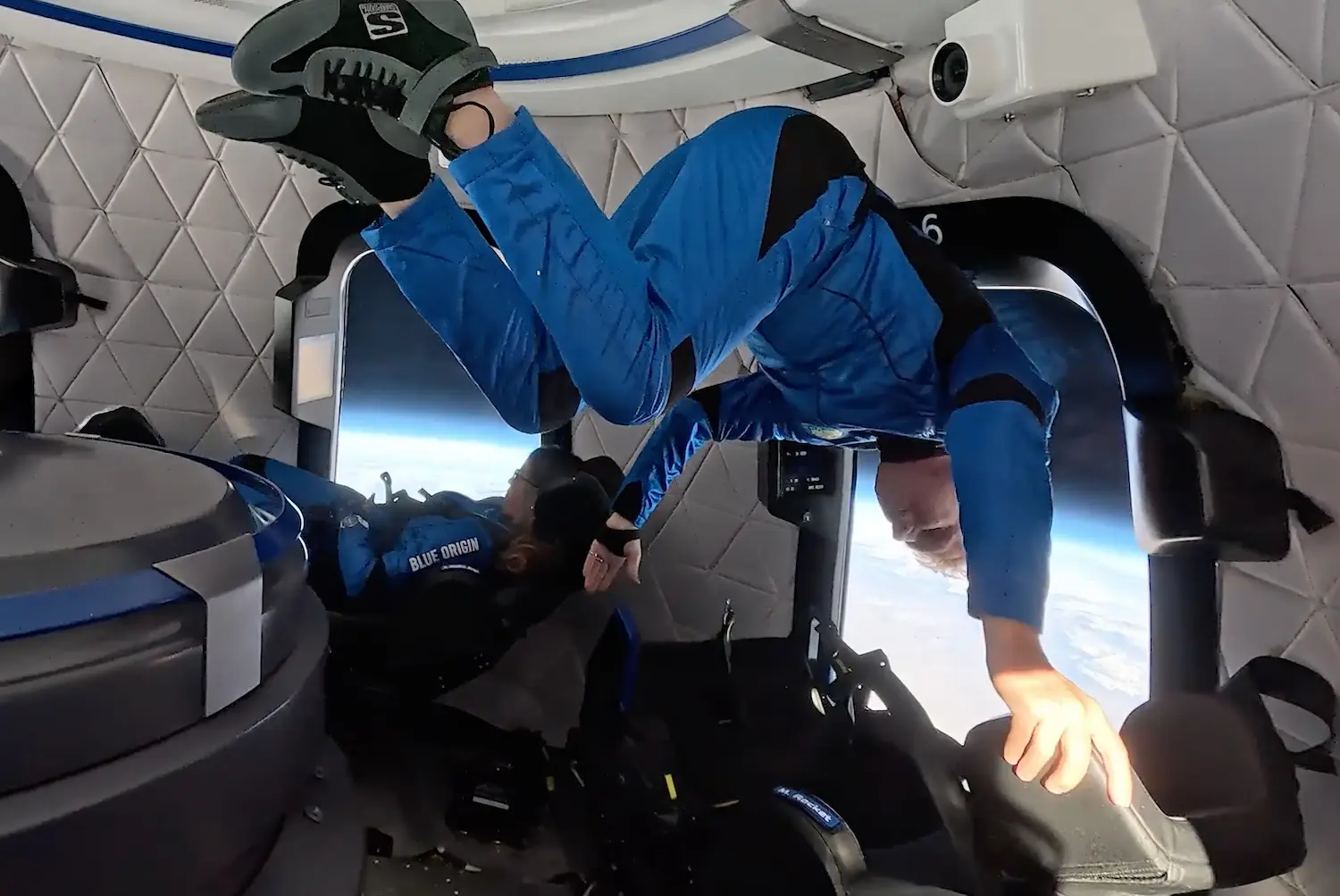
New Shepard Astronauts floating in space. Photo: Blue Origin
Astronaut 6
selected for the first full crew rehearsals of a New Shepard human flight
12+ Applications
standardized on one interaction and design system
$910K
saved in year one by the XR program, $7.75M projected over five
TLDR
What I was there to do: run product for the factory systems inside a well-funded rocket startup transitioning from an R&D experiment into a manufacturer that flies what it builds. I founded the design organization on the way, helped build the product management function, and helped scale and operationalize Enterprise Technology.
Who I led: nine direct reports in the Experience Design organization I founded and wrote the charter for. Before it existed, the TPMs, contractors, engineers and designers I pulled together to get the factory systems architected and built. And the astronaut strategy working group, which included former NASA astronauts, aerospace executives, and the chief revenue and chief marketing officers.
What lasted: the capabilities, not the projects. The design organization was elevated to a director-led function after I left, the XR program had been approved as a core capability, and the astronaut experience principles were carried past New Shepard to New Glenn and Blue Moon. The only real test of a capability somebody builds is whether it survives the person who built it.
01
The vehicle had a program. The systems around it did not.
August 2017. I was hired as a Senior Product Manager over the internal platforms that produce flight hardware: manufacturing execution, supply chain, and the operational workflows that govern mission readiness. Started the same day as Blue Origin's incoming CEO. We sat next to each other in orientation. He had been brought in to turn an R&D company into one that manufactures rockets and flies them.
That was the assignment underneath my assignment. Enterprise Technology was scaling from roughly thirty people to over three hundred. The vehicle had a program. The systems around the vehicle mostly did not.

BE-4 engine moving through the floor. Photo: Seattle Times
02
Nobody asked for design. It arrived inside a product management job.
I ran two of the least glamorous systems in the building. Ordering and Demand Management, which decides what gets bought and when. Factory Planning and Scheduling, which decides what gets built and when. Both became marquee platforms of Jules, the enterprise suite the company ran on. The challenge was unusual: build large-scale hardware the way software gets built.

The 0→1→N FlyWheel.
To accomplish this, I did not run them the way a nominal technical product manager might. No blind requirements gathering. I sat with the supply chain and manufacturing teams to understand what they needed and what they wanted, co-created the workflows and sketched the interfaces with them, built rough prototypes, took the feedback, iterated. The specification came last, once we knew what we were specifying.

Co-created process and workflow maps.
I was writing product strategy for the systems that build rockets, and the method that made those documents land was a design method. Nobody had asked for design. Design arrived anyway, inside a product management job, on the systems nobody was watching.
03
The method produced results, and the results produced requests.
The method produced results, and results produced requests. The factory planning program's vision shipped as Production by Jules, which argued that level loading and dispatch across all of Blue Origin should take less than two hours a week. I led that program and was a mainline contributor to the document.
Then the design language system. A global component library tying a dozen bespoke internal applications together with shared interface patterns. It raised the quality of the applications while reducing what it cost to build, operate and maintain them.
By the latter half of 2018, the question had stopped being whether design belonged in enterprise technology. It had become who was going to run it.

DLS applied to set of enterprise screens.
04
Naming the disciplines made it a capability, not a team people liked.
The demand became a function, Blue Origin's first Experience Design organization. The founding ran on paper. A UX process and practice deck, an executive summary charter, and the practice standards the group wrote for itself.
What the charter did was name the disciplines that sat across the whole company: service design, industrial and mechanical design, interaction and information design, content and visual design, prototyping, wayfinding, interior and space architecture, brand and communications, motion, film, packaging, apparel, design strategy, research and human factors.
Naming them is what made it a capability the company could requisition instead of a team people liked. Providing them meant teaching the other functions how to work with them.

Human experience design services and capabilities.

Cross-functional collaboration process map.
05
Twenty-one design changes caught in VR instead of in hardware.
Extended reality was surfacing in pockets around the company. The person running the budding XR capability turned to me to make it official: lead the corporate vision and strategy, write the memo, build the presentations, and get it funded.
The case was not that the technology was interesting. It was the engineering studies underneath it. Twenty-one design changes caught in VR instead of in hardware, $910,000 saved, and $7.75 million projected over five years. It went to the ET Council in October 2020, and was approved as a core capability.

XR creating value across the company.
06
Written about since 2005. I architected the astronaut experience program.
Blue Origin had been writing about the astronaut experience since 2005. What did not exist was an operational program: what the experience had to do, who was accountable for it, and what good meant when the customer is strapped to a rocket. Nobody was working on experience principles when I arrived.
I architected that program. Core output included the AX Guiding Principles. The vision was a life-changing experience through suborbital space flight. Several principles sat under it, including that the experience builds trust and confidence by providing for participants' emotional, physical and mental needs. The Guiding Principles were carried all the way to ratification with leadership.
A former NASA astronaut writing the skeptic's case against the program asked me for my critical read and input on it. His memo argued that somersaults in weightlessness, nice-looking flight suits, and the right to call oneself an astronaut are insufficient value to sustain a long-term spaceflight business. That document exists because the principles had to survive someone asking what the business actually was.
Then the New Shepard astronaut journey maps and the operational specifications built around the principles. Who does what, when, where, why and how, for the astronaut and across every operation that touches them, and the launch itself.

Creating the full astronaut journey map.
Which led to the service. The customer flows for commercial astronaut ticket sales as well as the first seat auction that closed at $28 million. The seat sales journey, from deposit through screening, FAA informed consent, the flight manifest, training, launch, and the relationship afterward. The selection framework for the first crew. The NS-12 launch run book, week by week from L-5 to flight, with named owners.

Astronaut selection framework.
07
I designed the service, then became its test subject as Astronaut 6.
I was selected as Astronaut 6 for the first full crew rehearsals of a New Shepard human-flight mission. That meant sitting inside the decisions I had written, in operating conditions, with the timeline and the procedures all running as designed.
Roughly a half-dozen full runs, soup to nuts. Astronaut arrival, suit and seat fittings, training, boarding, strapped into the capsule on the pad, wired to CAPCOM, the countdown running. Everything except the actual button being pressed to launch. Then landing recovery, and the extended engagement afterward.
What I brought back from those runs changed requirements and processes before the first human flight. Designing a service and then being its test subject is not a common way to check your own work. It is the most direct one.

Full Crew Rehearsal - Cohort 1 - The Krazy Kakapos.

Kyle boarding New Shepard on the launch pad during rehearsals.

The Krazy Kakapos mission patch that I designed.
08
The organization survived the person who built it.
I left in October 2021 just after New Shepard's second human flight. The Experience Design organization was elevated to a director-led function after I was gone, which is the only real test of a capability somebody builds. Whether it survives the person who built it. Astronauts continued to fly on New Shepard for the next four years, all while the team continued to learn and iterate on the service program we originally created. Although New Shepard has retired from flying, the lessons learned are being carried forward to New Glenn's orbital flight program as well as Blue Moon's moon landing and habitat program.

New Shepard astronauts, 2021–2025. Photo: Blue Origin
"Your calm demeanor, thoughtful contributions, impeccable work product, and the fact that this is not your primary job are all evidence of strong leadership."
Jeffrey Ashby, Chief of Mission Assurance at Blue Origin, Former NASA Space Shuttle Commander.
Blue Origin, August 2017 to October 2021. Senior Product Manager, then Senior Manager of Experience Design. Ran product for Ordering and Demand Management and Factory Planning and Scheduling, both of which became marquee platforms of the Jules enterprise suite. Built the design language system across twelve-plus internal applications. Founded the company's first Experience Design organization and wrote its charter. Co-authored the enterprise XR strategy approved by the ET Council in October 2020. Architected the astronaut experience program: the AX Guiding Principles, the New Shepard journey maps, the operational specifications, and the first crew selection framework. Astronaut 6 on the first full crew rehearsals.