Boeing, through Teague · 2013–2015
Research to requirements to a room no supplier had entered.
In 2013 Teague put me in front of the 777X program with an open mandate: find out what technology could do to an airplane cabin and the operation around it. I spent weeks in cabins watching how people actually fly, turned it into a thesis, and then into requirements the program could build against. In March 2014 I gave the keynote at Boeing's ACE event, which had never admitted a supplier.

ACE, Boeing, March 2014.
Sept 2013
spec-level imperatives delivered to 777X program leadership
20+ Rooms
one research body, four months, inside the program
March 2014
first supplier ever admitted to Boeing's ACE event, and its keynote
TLDR
What I was there to do: there was no brief. Find what the 777X cabin should be, and get it into the program.
Who I led: the in-cabin research program as its initiative lead, along with a cross-functional team of researchers, designers, mechanical engineers, and technical directors. Then the thesis, the program imperatives, and the roadshow, with 777X program leadership and Boeing executives in the room for most of it.
What lasted: the imperatives. The work continued on the 777X and past it, and Boeing asked for a second pass in 2017.
01
There was no brief. That was the assignment.
February 2013. Teague put me in front of 777X program leadership. They did not tell me what the cabin should do. They told me they had brought me in for what I knew about technology and connectivity, and that the assignment was to go find out what those could do to an airplane. Talk to passengers. Talk to flight attendants, pilots, maintenance crews. Find every opportunity technology had to change the cabin and the operation around it. Nobody could research the real question directly. The airplane did not exist yet, and neither did the expectations it would be judged against. What existed was the cabin people were flying that year, and the people flying in it.
02
Every traveling Teague employee became a field researcher.
Weeks in cabins. International long-hauls plus multi-segment domestic runs. Every traveling Teague employee became a field researcher for the duration, which is how a small studio gets a sample that size. Out of the observation set came eight passenger experience themes: Micro-Nesting, Planning and Preparation, Passing Time, Ad-Hoc Communities, Personal Well-Being, Noobs and Experts, Awkward Acceptance, Unjust Enrichment.
Micro-Nesting is what happens in the first two minutes on board. Passengers arrange their belongings by when they will need them, shoes off, coat as a blanket, reading material in the seat pocket, and they claim territory if the next seat is open. Passing Time is the one that pointed at the thesis. Passengers were not choosing between the movie and the magazine. We watched people run in-flight entertainment, a laptop and a crossword at the same time. The airplane was supplying one channel to a person already running four.
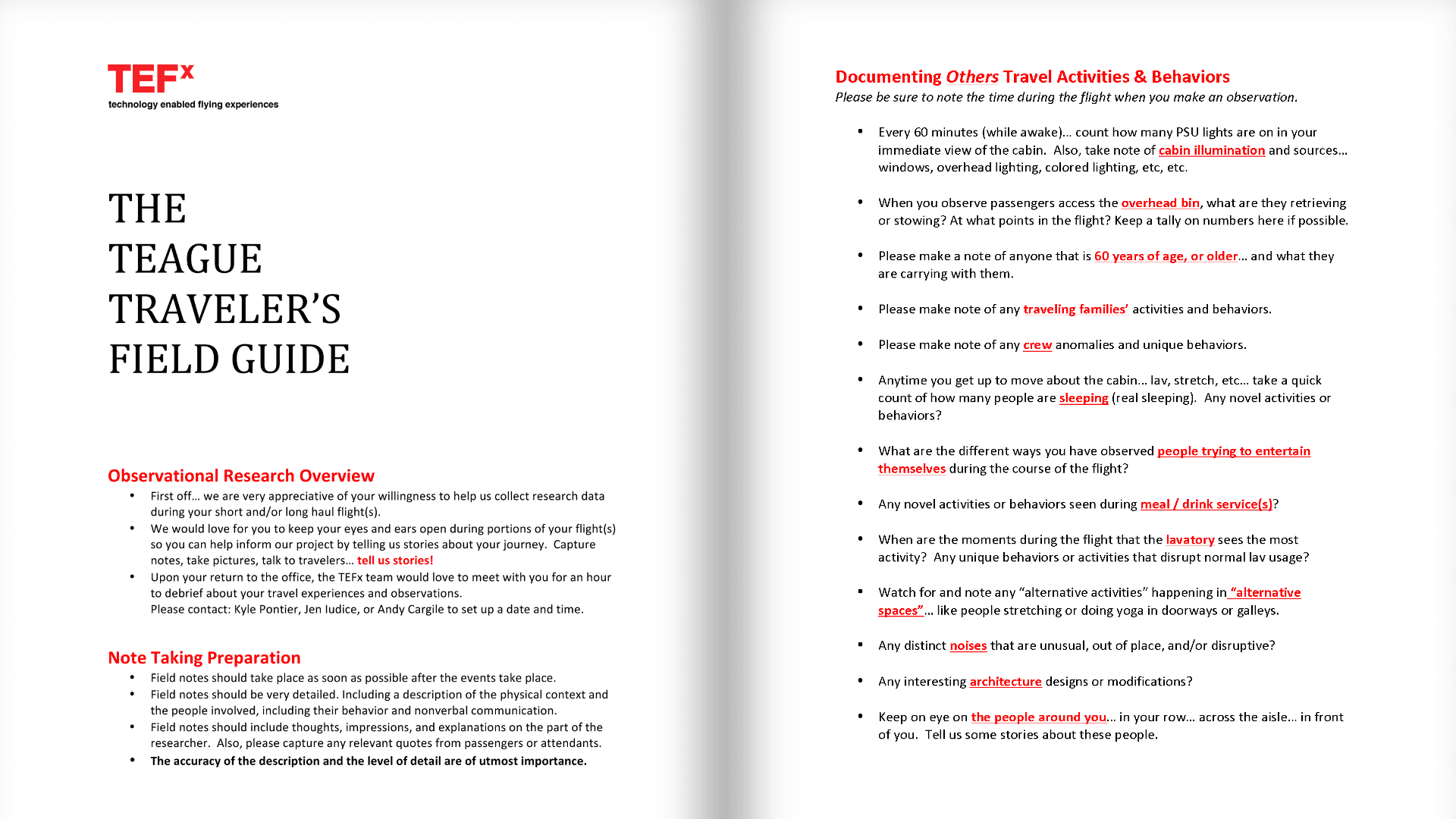
The Teague Traveler fieldbook, 2013. The prompts every traveling employee carried.

Eight passenger experience themes, synthesized from the observation set. 2013.
03
"Airbus is the Apple of the aviation industry."
I opened every Technology Enabled Flying Experiences (TEFX) talk the same way. "Airbus is the Apple of the aviation industry." Said in a room of Boeing executives, that got attention, which was the point. Aviation was still selling the magic of flight. Passengers had stopped grading airplanes against other airplanes and started grading them against everything else in their lives, most of which they were holding in their hands. The white paper's core premise was to skate to where the puck is going. Where it was going was not another airplane.

The gap the program had to close.

The opportunity space, mapped from people to things and pull to push.
04
The findings became spec-level requirements, the step most research skips.
This is the step most research never takes. They came back to me and said there was a great deal here worth doing, and asked which of it they had to do and which could wait. So I gave them a schema. Every requirement marked imperative or recommended. Wireless capacity for three to four devices per passenger. HD streaming. Consumer electronics disembedded from the airplane, so the cabin was not carrying the weight and the obsolescence of hardware that dates in three years. Seat-presence sensors. RFID passenger recognition. Smart-bag tags in cargo. Instrumented cabins that report what is happening inside them. Delivered to 777X program leadership in September 2013: six sheets, every line marked. The program took the imperatives as table stakes and built on the recommendations from there.
Then the step that made them a plan instead of a position. Each imperative was assigned to a program, existing capability to 777X and emerging capability to Excelsior. A requirement with nobody against it is a slide. A requirement with a program against it is on a roadmap.

TEFX imperatives model for 777X.

The full set, September 2013. Six requirement sheets.
05
Passenger experience does not buy its own way onto an airplane.
Look at that list again and most of it is not about passengers. Seat-presence sensors, RFID, smart-bag tags, instrumented cabins. Those are operations and maintenance. A technology justified by passenger delight has to win an argument about weight, cost and certification, and it usually loses. The same technology justified by what it saves an airline in turnaround time, fuel and maintenance hours pays for itself and gets on the airplane. Once it is on there, the passenger experiences it enables are already enabled.
That logic started here, in the shape of the imperatives, before I could put a number on it. I got the number later at B/E Aerospace, who made the interior commodities and sold them to the airlines, and so had to prove the case in dollars to survive. It is the part of this work I have used most since.
06
Twenty rooms, and then one that had never admitted a supplier.
One research body, over twenty rooms, four months. Among them: Teague brown bag, Aviation Quarterly, the Boeing stakeholder report-out, Product Studio, Boeing Marketing, 777X SAM and Global Tech, a Boeing VIP tour, Payloads, Systems, Cabin Systems. Findings do not travel on their own. Somebody has to carry them into every room that has to act on them.
ACE is Airplane Cabin Experience, the event where Boeing brings airline executives in to show them what the next airplane's cabin will do. Boeing runs others for aerodynamics and fuel. This one is the cabin, and it is Boeing talking to its own customers, so the room had never had a supplier in it. Teague had been a Tier 1 Boeing supplier for eighty years and had never been inside it. In March 2014 I gave the keynote. Nobody else from Teague was admitted.

The room at ACE, March 2014.
07
Full-cabin demonstrators, at one-to-one scale.
I kept building on the imperatives after delivery: full-cabin demonstrators at one-to-one scale, working technology where it existed and Wizard-of-Oz where it did not. The work also continued without me, on the 777X and past it. In 2017 Boeing asked for a second pass, and I ran TEFX again.

B/E Aerospace connectivity demonstrator in a 777X cabin mock-up, 2015.
The imperatives outlived the engagement that produced them.
I ran the in-cabin research, wrote the thesis, turned it into the imperatives delivered to 777X program leadership, and carried it through the roadshow and the keynote.
Event photography: Boeing. Demonstrator photograph: mine.