Reconciled · 2023–2026
Founded it, ran it, sold it. The hard part was making systems agree on what happened.
Reconciled automated the reconciliation between staffing agencies and the systems they bill through. The software was easy. The hard part was deciding when two records described the same shift.
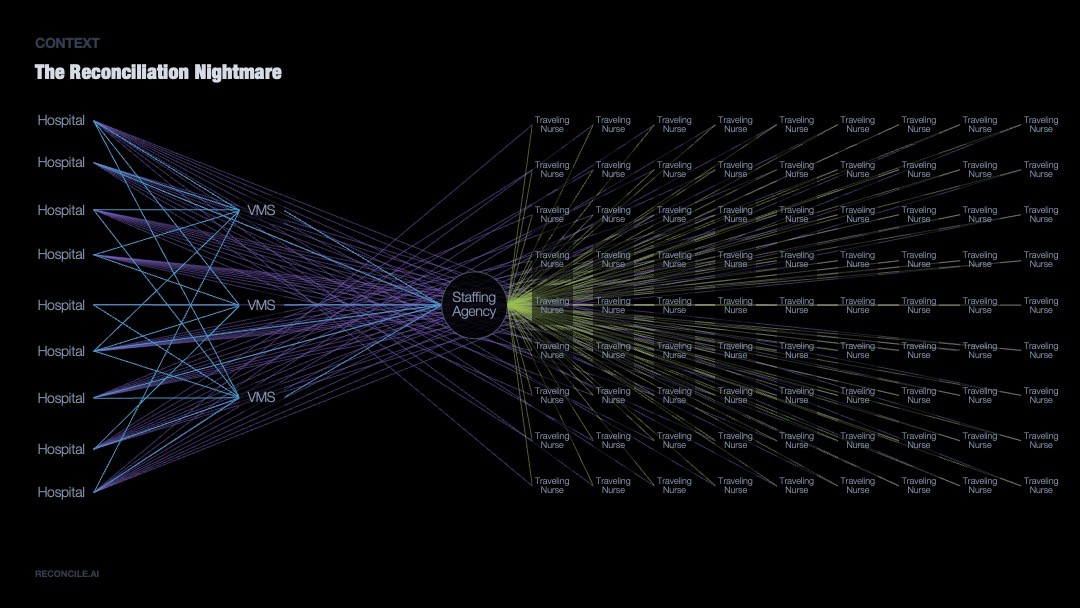
Entities, systems, and data not designed to understand each other.
Nine enterprise customers
grew two new logos a month after launch
90%+ less manual effort
and about 90% fewer write-offs
Acquired by LaborEdge, 2026
a larger player positioned to scale it within the industry
TLDR
What I was there to do: co-found and run an AI-native operations company for temporary-staffing back offices.
Who I led: product, engineering, design, operations and go-to-market, about a dozen people, plus the board and the fundraise.
What lasted: the company. It continues to run without me after the acquisition.
01
Everywhere else I owned a layer. Here I owned all of them.
Every other chapter of my career is a layer inside somebody else's system. Strategy at Teague, product at Blue Origin, a research group at Meta. At Reconciled I owned the product, the engineering and design organization, the operating model, the fundraising, and the outcome. That changes the work in one specific way. When you own a layer, a bad call is somebody else's problem to absorb. When you own all of them, every decision about what to build, and how to build it, is also a decision about whether the company is still here in six months.
02
Most people saw a workflow problem. We saw a data interoperability problem.
A staffing agency works across dozens of employers, several vendor management systems, its own timekeeping, and separate accounting platforms. Every one of them describes the same shift differently: different schemas, different names, different business rules. The invoice says one thing, the timecard says another, and nobody can prove which is right. The industry's answer was spreadsheets and people. Ours was a translation layer. Before anything could be reconciled, the systems had to describe the same reality the same way.

Five systems, five vocabularies, one real shift.
03
The classifier came third, on purpose.
Every new source of truth was hand-encoded into the canonical model with explicit rules. No guessing. We built the ground truth ourselves. It was slow and it was expensive, and it is the part a startup is most tempted to skip. After dozens of encoded variations, structure appeared, and new files were enough like the ones we had already solved to train against. Only then did we add a model. It runs through the same funnel, gets classified, and slots into the same matrix, with a human owning the judgment call. We built for about ninety-five percent confidence and kept a person at the point of ambiguity, because finance does not forgive a confident wrong answer.

Iterative evolution from model, to prototype, to production.
04
The system knew what was wrong. The user still had to trust it.
An automated verdict is worthless if the person accountable for every dollar will not act on it. Trust was the difference between using the system and overriding it. So every flagged discrepancy had to answer four questions at a glance: why it was flagged, which rule fired, what it was worth, and what to do next. Transparent, actionable, and defensible enough to hold up in an audit. Clean matches resolved themselves. The only things that reached a person were the ones that genuinely needed one.

A flagged dispute, broken down: rates and hours, vendor vs. ours, with the difference and the action surfaced.
05
We designed the whole back office and shipped the part that paid.
Reverse-invoice reconciliation was the wedge. What we were actually building was a platform: cash application, A/R reporting, dispute execution, direct invoicing, expense and commission management, payroll. Nine modules on one shared model, so each new one inherited the interoperability layer instead of rebuilding it. We shipped a few of them. The rest stayed on the roadmap, on purpose. A company that size builds what it can support and what customers will pay for now, and the discipline is knowing which of the nine that is in any given quarter.

The vision: a back office in a box operated by a single person.
06
Complex systems rarely fail for lack of information.
They fail because information cannot move, cannot be trusted, or cannot be understood across the boundaries between teams, tools, and organizations. That is not specific to staffing, and it is not specific to finance. It is the shape of most multi-system work. And the discipline scales. We built where a wrong match cost money. The same method holds where the bar is five nines and the cost is safety.
The architecture is written up in full. The canonical model, the matching engine, the rules hierarchy, and the interface that made the system's decisions legible.
Reconciled. March 2023 to April 2026. Co-founder and CEO. Raised a $1.1M VC-led pre-seed. Built the canonical data model and the matching architecture behind it, and led the company across product, engineering, design, operations and go-to-market. Nine enterprise customers, two new logos a month, more than ninety percent less manual effort and about ninety percent fewer write-offs. Acquired by LaborEdge, April 2026.